All
the excess water needs to drain out of the pot after watering
your orchid, this will prevent rotting roots; many orchids
grow on trees in the wild where their roots are exposed to
the air.
Check this section again for more tips.
It
was once thought that many orchids needed "stove houses" -
heated to around 100 to 120 degrees F, humidity hovering over
90 per cent, and deeply shaded; many orchids died under such
conditions. We now understand that most of them are comfortable
in the same sort of climate we humans enjoy. Very convenient.
Moth
Orchid (Phalaenopsis) Care and Growing Tips
Phalaenopsis
are warmth-loving perennial tropical orchid plants native
to jungles and rainforests of the Philippine Islands, south
to Indonesia and possibly Australia, east into New Guinea,
and a few species are found as far west as parts of eastern
India and Bangladesh. A variety is also known from forested
areas of Taiwan, the northernmost extent of the range of the
genus. As with all orchids, they can bloom every year or even
more than once each year, and can in theory live, for any
practical purpose, forever. They are often found near waterfalls,
in part shade, growing with the lush, leathery leaves hanging
sideways, the mist so draining off the plant in its perch
high in the trees or upon rocks - not in soil!
Phalaenopsis are known well for the length of time their blooms
can last - 3 or 4 months is typical; we have seen some last
a half a year in bloom. Consistent, even care as follows is
the key with these classically beautiful orchids.
Almost all must be kept warm - by which we mean nothing more
than comfortable indoor temperatures, 60 degrees F. minimum
at night, with a temperature increase during the day of about
10 to 15 degrees. They readily tolerate higher temperatures,
but will require more frequent watering if temperatures are
in the 90s. The principal exception is Phalaenopsis amabilis,
a pretty Taiwanese variety with smaller white flowers, which
is perfectly happy with nights as low as 40 degrees F occasionally
and 48 degrees routinely. If it is your desire to bring the
plant into bloom again, it will be necessary to allow it to
have night temperatures around 55 to 58 degrees F for a period
of no less than six weeks, followed by normal warmer temperatures.
As Phalaenopsis have no pseudobulbs (the thick, bulb like
structure found on many other orchids), and so cannot conserve
much water, they require watering frequent enough to maintain
a level of moisture in the pot that is not dripping wet at
all times, nor dry ever; evenly, consistently moist. Of course
it will be wetter just after watering but the point is to
never let the plants dry out completely. They can be watered
best by placing them in a sink and running cold water into
the pot for 10 or 15 seconds, or alternatively a couple of
ice cubes can be placed on the bark medium in the pots and
allowed to melt, the slower trickle of water providing enough
moisture to sustain the plant. In this second method, the
plants should nonetheless be watered thoroughly from time
to time to allow minerals deposited in the bark medium to
be rinsed out. Morning is the best time to water any orchids.
Twice a week while blooming will usually be sufficient for
a large plant; if two flower stems are present, three times
may be required. When not blooming, once per week is usually
enough.
Phalaenopsis greatly appreciate frequent applications of very
mild dilutions of fertilizer. Many commercial brands work
well, such as Miracle Grow, Peters, Dyna Grow, and so on;
in most cases, the label will provide information on how much
fertilizer to add to a gallon of water to make a solution
- but it is best to make a far, far weaker one. For example,
if the label calls for 1 tablespoon of fertilizer granules
per gallon of water, to be applied once per month, try instead
about one half teaspoon of granules per gallon, applied every
other watering. Premixed fertilizer can be kept for some time
under a sink, or in a cabinet out of reach of children (and
away from light, which will allow algae to grow in the water
in unsightly fashion).
Phalaenopsis are plants of shady forests, and so their needs
for light can be met easily. One half hour, up to an hour,
of full sun in the early morning, OR sun diminished by sheer
curtains for a longer period, OR very bright shade, such as
a spot in a sunroom that happens never to be in full sun,
are some variations any of which would provide enough light
to allow the plants to grow and bloom.
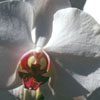
The last item of concern is you! Take a little time to admire
the stately display; go closer and explore the intricacies
of the floral structure. We think you'll find a bit of peace
of mind, a brief mental vacation in your piece of tropical
paradise.



 All
the excess water needs to drain out of the pot after watering
your orchid, this will prevent rotting roots; many orchids
grow on trees in the wild where their roots are exposed to
the air.
All
the excess water needs to drain out of the pot after watering
your orchid, this will prevent rotting roots; many orchids
grow on trees in the wild where their roots are exposed to
the air. It
was once thought that many orchids needed "stove houses" -
heated to around 100 to 120 degrees F, humidity hovering over
90 per cent, and deeply shaded; many orchids died under such
conditions. We now understand that most of them are comfortable
in the same sort of climate we humans enjoy. Very convenient.
It
was once thought that many orchids needed "stove houses" -
heated to around 100 to 120 degrees F, humidity hovering over
90 per cent, and deeply shaded; many orchids died under such
conditions. We now understand that most of them are comfortable
in the same sort of climate we humans enjoy. Very convenient.